
You've probably heard the term "open-ended play" — in parenting articles, toy descriptions, Waldorf and Montessori contexts. But what does it actually mean? And why does it matter enough for child development researchers and educators to write so much about it?
Here's a clear, practical explanation — what open-ended play is, what it isn't, why it matters, and how to support it at home.
What Is Open-Ended Play?
Open-ended play is play without a predetermined outcome. It's play where the child decides what happens, how it happens, and what it means — where there is no right or wrong way to proceed, no goal to achieve, no correct answer.
A child who picks up a wooden block and decides it's a car, then a house, then a baby, then a spaceship — that's open-ended play. A child who puts a doll to sleep, wakes it up, feeds it, takes it on an adventure, and makes up the entire story as they go — that's open-ended play. A child who builds something with blocks, knocks it down, and builds something completely different — that's open-ended play.
The defining characteristic is that the child is the author. The play goes wherever the child takes it.
"Open-ended play isn't a type of activity. It's a quality of play — the quality of being led entirely by the child."
Open-Ended vs Closed-Ended Play
Understanding open-ended play is easier when you compare it to closed-ended play:
- Has a specific goal or correct outcome
- Rules are defined in advance
- The toy or game directs how to play
- There is a right and wrong way to proceed
- Examples: jigsaw puzzle, board game, electronic toy
- No predetermined outcome
- The child makes the rules
- The child directs how to play
- There is no right or wrong way
- Examples: blocks, doll play, drawing, sand play
Both types of play have value. Closed-ended play builds specific skills — a puzzle develops spatial reasoning and persistence toward a defined goal. Open-ended play builds broader capacities — creativity, imagination, self-direction, emotional intelligence.
In early childhood (roughly ages 2 to 7), open-ended play is particularly important. These are the years when imagination, creativity, and self-regulation are being built from the ground up. Open-ended play is the primary vehicle for this development.
Why Open-Ended Play Matters
It develops creativity
When a child plays open-endedly, they generate everything: the story, the rules, the meaning, the next move. This generation is creative work — and it's practice that compounds over years of play. A child who has spent hundreds of hours authoring their own play develops creative thinking capacities that show up in every area of their life.
It builds self-direction and executive function
Open-ended play is child-led — the child must decide what to do next, manage their own attention, and maintain focus on a self-chosen goal. This is exactly what executive function involves. Research consistently finds that children who engage in rich open-ended play develop stronger executive function — the ability to plan, focus, remember, and manage impulses.
It supports emotional development
Children use play to process their emotional experiences. A child who felt scared at the doctor might play "doctor" for weeks afterward, working through the experience in a safe, controlled context. A child who is anxious about a new sibling might act out family scenarios with dolls. Open-ended play gives children a space to process feelings that they can't yet put into words.
It develops language
Children narrate their open-ended play constantly — out loud to themselves, or with other children. This narration is extraordinary language practice: complex vocabulary, narrative structure, dialogue, the subjunctive mood ("and then she would say..."). Children who engage in rich imaginative play consistently develop stronger language skills.
What Open-Ended Play Looks Like at Different Ages
Ages 1–2
Simple object exploration — banging, stacking, dropping, filling and emptying. Using objects symbolically for the first time (a block becomes a phone). Very early pretend play begins around 18 months.
Ages 3–5
The peak of open-ended imaginative play. Children develop elaborate scenarios, sustained narratives, complex characters, and rich fantasy worlds. A child at this age can spend hours in a single play scenario, maintaining a story across days or weeks. This is when a Waldorf doll becomes a full companion — with a name, a history, and a role in the child's play world.
Ages 6–8
Open-ended play becomes more social and more structured by the children themselves. Rules become important — but rules the children set, not rules from a game. Play scenarios become more realistic and more emotionally complex.

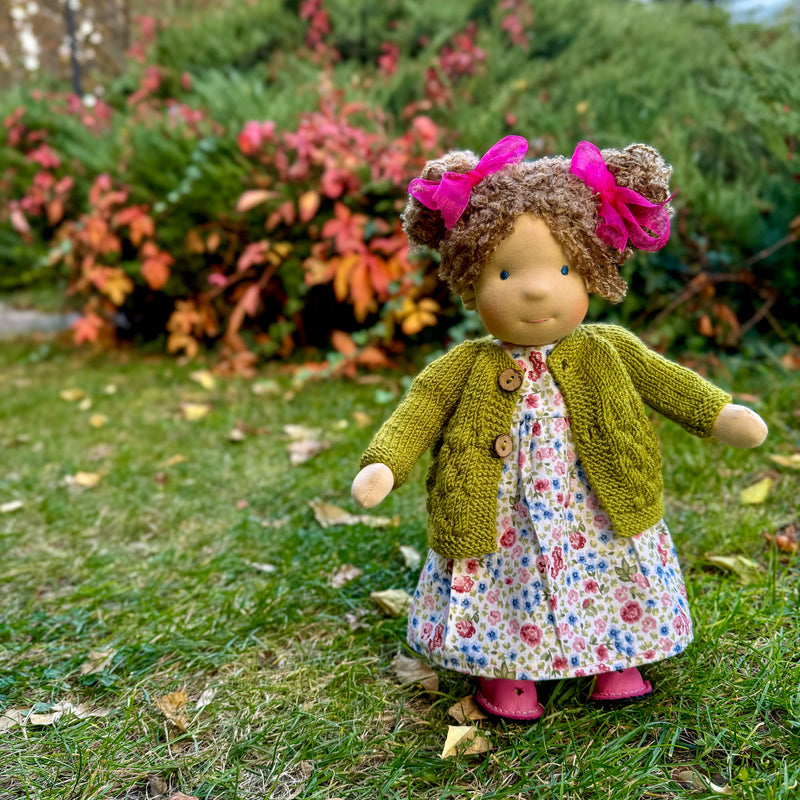
A Waldorf doll is one of the most open-ended toys available — no batteries, no programme, no right way to play. Everything is decided by the child.
The Best Toys for Open-Ended Play
The toys that support open-ended play best are the ones that do the least — leaving the most to the child's imagination:
- Wooden blocks — can become anything; no fixed play script
- Handmade dolls — minimal features leave the emotional story to the child
- Play silks — a piece of fabric that can be anything
- Loose parts — stones, shells, sticks, pinecones — natural objects with infinite play possibilities
- Art materials — beeswax crayons, paint, clay — the child creates rather than consumes
- Sand and water — endlessly malleable, endlessly open
- Provide open-ended toys — fewer, simpler, and more natural
- Protect unstructured time — children need time that isn't scheduled or directed
- Resist directing the play — follow the child's lead, don't impose a narrative
- Allow the mess — open-ended play often spreads out; the mess is part of it
- Reduce screen time — screens provide content; open-ended play requires the child to generate it
- Be comfortable with boredom — boredom is often the doorway into open-ended play
Handmade Waldorf dolls by Heartmade Doll
No batteries. No programme. No right way to play. Organic cotton, natural wool, SGS certified safe — and completely open-ended.
Shop Handmade Dolls →Frequently Asked Questions
What is open-ended play?
Open-ended play is play without a predetermined outcome — the child decides what happens, how it happens, and what it means. There is no right or wrong way to proceed. The child is the author, and the play goes wherever they decide.
What are examples of open-ended play?
Building with wooden blocks, playing with a doll, drawing freely, playing with sand or water, using play silks imaginatively, outdoor nature play, and cooperative pretend play with other children. These activities share the characteristic that the child determines the direction.
What is the difference between open-ended and closed-ended play?
Closed-ended play has a specific goal or correct outcome — a puzzle, a board game, an electronic toy. Open-ended play has no predetermined outcome — the child decides everything. Both have value, but open-ended play is particularly important in early childhood.
What toys support open-ended play?
Simple, natural, ambiguous toys that can become anything: wooden blocks, handmade dolls, play silks, loose parts, art materials, and sand and water. These toys have no fixed play script — everything about how they're used is decided by the child.