
Screens are everywhere in modern childhood. Tablets, educational apps, YouTube videos, interactive toys with built-in displays — the digital world reaches children younger and younger. Many parents feel the pull in two directions: screens are convenient, sometimes genuinely educational, and hard to avoid. But something nags. Is this really what a two-year-old needs?
The research is fairly clear: for toddlers and young children, the best toys are screen-free, open-ended, and made from natural materials. Not because screens are evil, but because the kind of play that screens enable is fundamentally different from the kind of play that builds the capacities children need most.
Why Screen-Free Matters for Toddlers
Screen-based toys — tablets, interactive apps, electronic learning toys — share a characteristic: they provide content. The child receives stimulation, responds to prompts, and consumes what the device produces. This is fundamentally passive, even when it seems interactive.
Screen-free, open-ended toys work the opposite way. A wooden block, a simple doll, a piece of silk — these provide almost nothing. The child must generate everything: the story, the rules, the meaning, the next move. This active generation is where the developmental work happens.
"A screen gives a child something to watch. A wooden block gives a child something to think."
Most major child development and paediatric organisations recommend avoiding screens entirely for children under 2, and limiting to one hour per day for children 2 to 5. The reasoning is developmental — not moral. At these ages, children's brains are building the foundational capacities for creativity, language, attention, and self-regulation that will serve them throughout life. Open-ended, hands-on play builds these capacities in ways screens cannot replicate.
The Best Screen-Free Toys for Toddlers
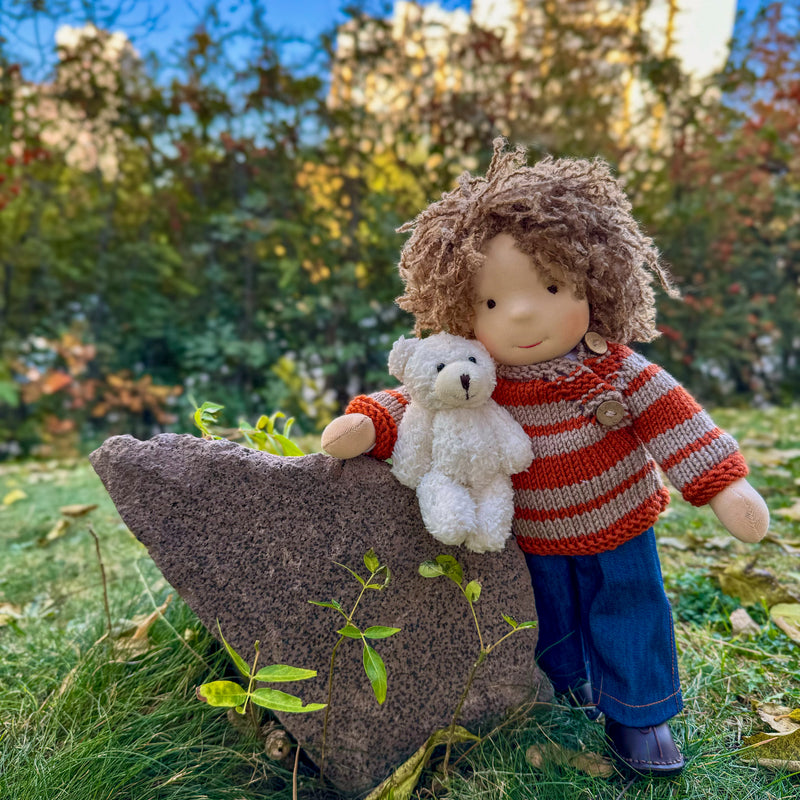
A Waldorf doll is one of the most screen-free toys imaginable — no batteries, no sounds, no lights, no programmed responses. Everything the doll does, it does because the child decides. The result is some of the richest imaginative play a toddler can engage in: naming the doll, caring for it, dressing and undressing it, building stories around it. A Heartmade Doll is made from organic cotton and natural wool, independently tested by SGS to ASTM F963-23, and comes complete with a full set of clothing and a small teddy bear companion.
Shop Handmade Dolls →A set of simple wooden blocks is one of the most enduring screen-free toys ever made — and with good reason. Building with blocks develops spatial reasoning, problem-solving, fine motor skills, and early mathematical thinking, all without a single pixel. A toddler stacks and knocks them down; a four-year-old builds entire cities. The same set works across years of play. Choose solid, unfinished or naturally finished wood without synthetic coatings.
Drawing is one of the oldest and most developmentally rich screen-free activities for young children. Beeswax crayons are made from natural beeswax and non-toxic pigments — they're safer than paraffin if mouthed, easier for small hands to grip, and produce a richer, more satisfying colour. A large pad of plain white paper and a set of beeswax crayons is an endlessly reusable, deeply creative gift that costs far less than most electronic alternatives.
Sheer, plant-dyed silk scarves are a wonderful screen-free toy for toddlers — sensory, open-ended, and endlessly versatile. At 18 months, a child uses them for peek-a-boo and sensory exploration. At 3, they become capes and rivers and magic carpets. At 5, they're costumes and story props. One of the few toys that genuinely evolves with the child through multiple stages of play, with zero technology required.
A small drum, a simple xylophone, or a pentatonic flute gives a toddler direct, immediate, screen-free feedback — make a sound, hear a sound. Music-making develops auditory discrimination, rhythm, coordination, and self-expression. Choose simple instruments made from natural materials — wood, metal, natural skin — rather than plastic electronic keyboards that do the music for the child.

No batteries. No sounds. No screen. Just a child, a doll, and whatever story they decide to tell.
Making the Transition Away from Screens
If your toddler is used to screens, transitioning to screen-free play can take adjustment. Screens have a very high stimulation level — the pace, sound, and colour of digital content is designed to capture and hold attention. Natural toys are quieter by comparison, at least initially.
- Expect a transition period — "I'm bored" is often the precursor to imaginative play. The boredom is productive; let it sit.
- Start with short screen-free periods — an hour in the morning, then gradually extend. Cold turkey can create more resistance than needed.
- Be present initially — sit near the child and let them see you engaged with something quiet. Your calm presence models the pace of screen-free time.
- Don't fill every moment — the goal isn't to replace screen time with structured activities. Unstructured, open-ended time is the point.
- Self-generated creativity — the child creates content rather than consuming it
- Sustained attention — natural play can last hours; screens change content every few seconds
- Physical engagement — hands-on play supports motor development screens cannot
- Emotional regulation — boredom, frustration, and resolution are all part of screen-free play
- Language and narrative — children narrate their play constantly, building vocabulary naturally
- Social skills — cooperative play requires real-time negotiation and compromise
Handmade Waldorf dolls by Heartmade Doll
Organic cotton, natural wool, SGS certified safe. No electronics, no batteries, no screens — just open-ended play. Ships worldwide in 3–5 days.
Shop Handmade Dolls →Frequently Asked Questions
What are the best screen-free toys for toddlers?
The best screen-free toys are open-ended, made from natural materials, and designed to support imaginative play. Top picks include handmade Waldorf dolls, wooden building blocks, beeswax crayons, play silks, and simple musical instruments.
Why are screen-free toys better for toddlers?
Screen toys provide content for passive consumption. Screen-free, open-ended toys require the child to generate content — to imagine, create, and problem-solve. This active engagement builds creativity, executive function, language, and emotional intelligence in ways passive consumption cannot.
How do I keep my toddler entertained without screens?
Provide open-ended toys and protect unstructured time. Toddlers with simple natural toys and adequate unstructured time rarely struggle to entertain themselves. The challenge is usually the transition away from screens — expect a period of adjustment.
Are Waldorf dolls screen-free toys?
Yes — entirely. No batteries, no sounds, no electronic components. A Waldorf doll does nothing on its own; everything it does, it does because the child decides. This makes it one of the most developmentally rich screen-free toys available.