
If you've been reading about Waldorf dolls, you've probably come across the word "Waldorf" used as both an educational term and a toy category — sometimes interchangeably, sometimes in ways that aren't entirely clear. What exactly is Waldorf education? What does it have to do with a doll? And do you need to be a Waldorf parent to care about any of this?
The short answer to the last question is no. But understanding the philosophy helps explain why Waldorf toys are made the way they are — and why so many parents who have never set foot in a Waldorf school find themselves drawn to them.
Who Was Rudolf Steiner?
Rudolf Steiner was an Austrian philosopher and educator who, in 1919, founded the first Waldorf school in Stuttgart, Germany. The school was established for the children of workers at the Waldorf-Astoria cigarette factory — hence the name.
Steiner's educational philosophy was radical for its time. While most schools of the era focused on rote memorisation and academic drilling, Steiner argued that education should develop the whole child — not just the intellect, but the artistic, emotional, and practical dimensions of human experience.
Waldorf schools have since spread to over 70 countries. The approach has evolved over a century, but its core principles — imagination, natural materials, age-appropriate development, and the centrality of play in early childhood — remain intact.
What Is Waldorf Play Philosophy?
At the heart of Waldorf education is a specific idea about what play is for. Steiner believed that play is the primary work of early childhood — not a break from learning, but the vehicle through which young children develop the capacities they'll need for the rest of their lives.
Waldorf play philosophy has three central principles:
1. Open-ended play over directed play
A toy that tells a child how to play limits the child. A toy that does nothing on its own — a simple doll, a wooden block, a piece of silk — leaves everything to the child's imagination. Waldorf philosophy strongly favours the latter. The less the toy does, the more the child has to do — and that's where genuine development happens.
2. Natural materials over synthetic ones
Steiner believed that the materials children interact with in early childhood matter — not just for safety, but for sensory development. Natural materials like wood, wool, cotton, and beeswax have textures, weights, and qualities that synthetic materials can't replicate. A child who handles natural materials develops a different sensory relationship with the physical world.
3. Imagination over stimulation
Electronic toys, screens, and highly stimulating toys do the imagining for the child. Waldorf philosophy argues that this is not merely unhelpful but actively counterproductive in early childhood — it trains children to be passive recipients of stimulation rather than active creators of experience. A simple doll with a minimal face leaves the emotional landscape entirely to the child.
"Play is the work of childhood. The right toy doesn't do the playing — it makes space for the child to play."
What Are Waldorf Toys?
Waldorf toys are any toy that embodies these principles: open-ended, natural materials, simple enough to leave room for imagination. The most common examples include:
- Handmade dolls — soft, natural materials, minimal facial features that allow the child to project emotion
- Wooden blocks — no fixed play pattern; can become anything
- Play silks — simple fabric that can be a river, a cape, a tent, or a sky
- Beeswax crayons — natural pigments, satisfying texture, supports artistic development
- Simple musical instruments — pentatonic flutes, lyres, small drums
- Natural fibre animals — wool felt, cotton stuffed animals without plastic parts
What Waldorf toys don't include: batteries, screens, electronic components, fixed play scripts, or synthetic materials that off-gas chemicals.


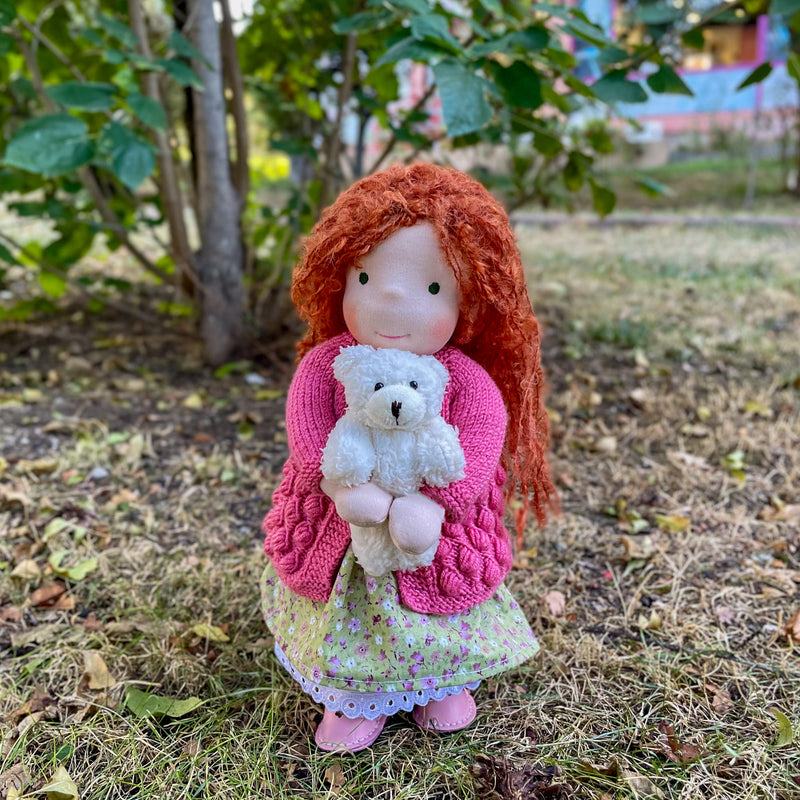
Waldorf dolls embody the core principles of Waldorf play — natural materials, minimal features, open-ended play.
Why the Minimal Face?
For many parents encountering Waldorf dolls for the first time, the minimal facial features are the first thing that raises a question. Why doesn't the doll have a proper face?
The answer is rooted in Waldorf play philosophy. A doll with a fixed, detailed expression — always smiling, always surprised — constrains the emotional story a child can tell with it. If the doll always smiles, it can only ever be happy.
A doll with minimal features — soft embroidered eyes and a gentle suggestion of a mouth — can be whoever the child needs it to be. Happy, worried, brave, sad, curious. The child fills in the emotional landscape, which builds empathy and emotional intelligence in ways that a fixed-expression doll simply cannot.
- Imaginative and creative thinking — the child authors the story
- Emotional intelligence — projecting and processing emotions through play
- Language development — narrating stories and conversations
- Empathy — caring for the doll, understanding its needs
- Fine motor skills — dressing, undressing, arranging
- Social development — role play, cooperative play with other children
Do You Have to Be a Waldorf Parent?
No. Many parents who are drawn to Waldorf toys have never heard of Rudolf Steiner, don't send their children to Waldorf schools, and have no particular interest in educational philosophy. What they do share is a set of values: natural materials, fewer screens, open-ended play, and toys that last more than a season.
Waldorf toys align with those values whether or not you know their origin. A handmade doll made from organic cotton and natural wool is a better toy for a young child regardless of what you call it — and the principles that shaped its design hold up whether they come from a 1919 German philosopher or from your own instincts as a parent.
Waldorf vs Montessori: What's the Difference?
Both Waldorf and Montessori are child-centred educational philosophies that value hands-on learning and natural materials, and they're often mentioned together. The key differences:
- Montessori emphasises independence, self-directed activity, and carefully structured learning materials. Children choose their own work from a prepared environment.
- Waldorf emphasises imagination, rhythm, and artistic expression. The teacher plays a more active role in storytelling, group activity, and seasonal celebration.
- Both prefer natural toys and screen-free early childhood. Both value the child's developmental stage over academic acceleration.
In practice, many parents draw from both traditions without committing fully to either — taking what resonates and leaving what doesn't.
Handmade Waldorf dolls by Heartmade Doll
Organic cotton, natural wool, minimal features, maximum imagination. SGS certified safe. Ships worldwide in 3–5 days.
Shop Handmade Dolls →Frequently Asked Questions
What is Waldorf education?
Waldorf education is a holistic educational approach developed by Rudolf Steiner in 1919. It emphasises imagination, creativity, and whole-child development — intellectual, artistic, and practical — over standardised testing and academic acceleration.
What is Waldorf play philosophy?
Waldorf play philosophy values open-ended, imaginative play using simple, natural materials. Play is seen as the primary work of childhood — the vehicle through which young children develop creativity, emotional intelligence, language, and social skills.
What are Waldorf toys?
Waldorf toys are open-ended, made from natural materials — wood, wool, cotton, silk, beeswax — and designed to support rather than direct imaginative play. They have no batteries, no electronic components, and no fixed play scripts.
Do you have to follow Waldorf education to use Waldorf toys?
No — you don't need to send your child to a Waldorf school or follow Waldorf principles. Many parents who value natural materials, open-ended play, and screen-free childhood find Waldorf toys align with their instincts, regardless of any formal educational approach.
What is the difference between Waldorf and Montessori?
Montessori emphasises independence and self-directed activity with structured learning materials. Waldorf emphasises imagination, rhythm, and artistic expression with a more active teacher role. Both value natural toys and screen-free early childhood.