
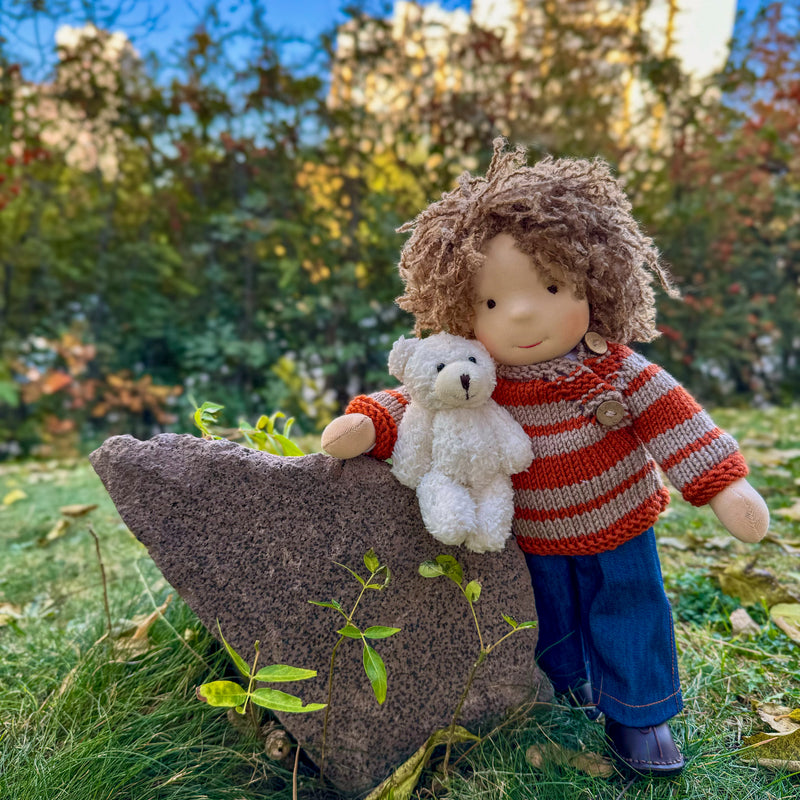
If you've been searching for natural, handmade dolls and come across the term "Steiner doll," you might be wondering whether it's different from a Waldorf doll — or whether these are two names for the same thing. The short answer is the latter: a Steiner doll and a Waldorf doll are the same toy, described by two different names that come from the same source.
Here's a clear explanation of where the name comes from, what it means, and what to look for.
Where the Name Comes From
Both "Waldorf" and "Steiner" refer to the same person: Rudolf Steiner, an Austrian philosopher and educator who founded the Waldorf educational movement in 1919.
The name "Waldorf" comes from the Waldorf-Astoria cigarette factory in Stuttgart, Germany, where Steiner founded his first school for the children of factory workers. The factory owner asked Steiner to establish a school — and the resulting institution took the factory's name.
"Steiner" simply refers to Rudolf Steiner himself.
The two terms are used in different parts of the world. "Waldorf" is more common in the United States, continental Europe, and many other regions. "Steiner" is the preferred term in the United Kingdom, Australia, and New Zealand, where schools following this educational approach are typically called Steiner schools rather than Waldorf schools. The dolls follow the same naming convention — the same toy is called a Waldorf doll or a Steiner doll depending on where you are.
"Waldorf doll, Steiner doll — same toy, same tradition, same design philosophy. The name depends on where you are in the world."
What Makes a Steiner Doll a Steiner Doll
Whether it's called a Steiner doll or a Waldorf doll, the defining characteristics are the same — rooted in Rudolf Steiner's philosophy of early childhood education:
- Natural materials — organic cotton or natural cotton fabric, natural wool filling, natural yarn for hair. No synthetic materials, no plastic components.
- Minimal facial features — soft embroidered eyes and a gentle expression, designed to leave the emotional landscape open for the child to project onto the doll.
- Child-like proportions — a rounded head, soft body, simple limbs. Not adult proportions — a child-form that invites nurturing rather than aspiration.
- Handmade construction — the key steps (head sculpting, face embroidery, hair attachment) are performed by hand. This isn't just tradition — it's what makes the subtle, variable quality of a Steiner doll possible.
- Removable clothing — designed to be dressed and undressed, supporting fine motor development and dressing play.
Rudolf Steiner and the Philosophy Behind the Doll
Rudolf Steiner (1861–1925) developed his educational philosophy — now called Waldorf or Steiner education — based on a belief that early childhood is a uniquely important developmental period that should be protected from premature academic pressure and instead supported through imagination, artistic activity, and natural play.
Steiner believed that the toys children play with in early childhood shape their developing capacities. A toy that does everything for the child — that flashes, talks, and plays itself — leaves the child passive. A toy that does nothing on its own — that is simple, natural, and open-ended — invites the child to bring everything: the story, the characters, the emotions, the meaning.
The Steiner doll embodies this philosophy. Its minimal face is a deliberate choice — a doll that always smiles can only ever be happy. A doll with a soft, open expression can be whatever the child needs it to be in the moment.
- Natural materials — organic cotton, natural wool, no synthetic components
- Minimal facial features — embroidered, open expression
- Child-like proportions — rounded head, soft body
- Handmade construction — key steps done by hand
- Open-ended design — no fixed play script
- Removable clothing — supports dressing play and fine motor development
Steiner Doll vs Waldorf Doll — Is There Any Difference?
No meaningful difference in the toy itself — the design tradition, materials, and philosophy are identical. The only difference is terminology, which varies by region.
If you're in the UK or Australia and searching for a "Steiner doll," you'll find the same kind of toy as someone in the US searching for a "Waldorf doll." Makers who use "Waldorf-inspired" or "Steiner-inspired" in their descriptions are referring to the same tradition.
At Heartmade Doll, our products are sometimes described as "Waldorf-inspired Steiner dolls" precisely because we sell to customers in both traditions and want to be findable by both searches. The doll itself is the same: organic cotton, natural wool, handmade in Ankara, Turkey, and independently certified by SGS to ASTM F963-23.
What to Look for When Buying a Steiner Doll
The same principles that apply to buying a Waldorf doll apply to a Steiner doll — because they're the same thing:
- Verified natural materials — organic cotton body, natural wool filling, natural yarn hair
- Independent safety certification — SGS, Intertek, or similar, with a verifiable report number
- Made to order — a genuine handmade doll takes 3 to 5 days to produce; same-day dispatch suggests mass production
- Personalisation — hair colour, eye colour, and skin tone options
- Transparent maker — who makes it, where, and how

A Heartmade Doll — sometimes called a Waldorf doll, sometimes a Steiner doll. Same tradition, same materials, same handmade quality.
Handmade Waldorf Steiner dolls by Heartmade Doll
Organic cotton, natural wool, SGS certified to ASTM F963-23. Personalised with hair, eyes, and skin tone. Made to order in Ankara — ships worldwide.
Shop Handmade Dolls →Frequently Asked Questions
What is a Steiner doll?
A Steiner doll is another name for a Waldorf doll — a soft, handmade doll from natural materials with minimal facial features, designed for open-ended imaginative play. "Steiner" is most commonly used in the UK and Australia; "Waldorf" in the US and Europe. Both refer to the same toy tradition rooted in Rudolf Steiner's educational philosophy.
What is the difference between a Steiner doll and a Waldorf doll?
No meaningful difference — they're two names for the same toy. "Waldorf" comes from the Waldorf-Astoria factory where Steiner founded his first school. "Steiner" refers to Rudolf Steiner himself. The design tradition, materials, and philosophy are identical.
Who was Rudolf Steiner?
Rudolf Steiner (1861–1925) was an Austrian philosopher and educator who founded the Waldorf educational movement in 1919. He emphasised imagination, artistic expression, and natural materials in early childhood — principles that shaped the design of what are now called Waldorf or Steiner dolls.
Are Steiner dolls safe for children?
A well-made Steiner doll from organic cotton and natural wool is among the safest toys available. Always look for independent safety certification with a verifiable report number — "non-toxic" claims without documentation are unverified.