
If you've been researching natural toys for young children, you've probably come across both Waldorf and Montessori recommendations — sometimes in the same breath, as if they're interchangeable. They're not. They share important values, but they come from different philosophies and produce different kinds of toys.
Understanding the difference helps you choose more intentionally — and helps you understand why a Waldorf doll is designed the way it is, and what it's actually for.
The Philosophies: Where They Come From
Waldorf
Waldorf education was developed by Rudolf Steiner in 1919. It emphasises imagination, artistic expression, and the rhythm of childhood. In Waldorf philosophy, early childhood is a time for deep imaginative play — not early academic preparation. Toys should be simple, natural, and open-ended: they should leave as much as possible to the child's imagination.
Montessori
Montessori education was developed by Maria Montessori in the early 1900s. It emphasises independence, self-directed learning, and a carefully prepared environment. Montessori materials are typically designed to teach specific skills — practical life skills, sensory discrimination, early mathematics and literacy. The child chooses their own work and masters it at their own pace.
"Both Waldorf and Montessori put the child at the centre. But they have different ideas about what the child needs most."
Side-by-Side Comparison
| Area | Waldorf | Montessori |
|---|---|---|
| Core focus | Imagination & artistic expression | Independence & practical skills |
| Play type | Open-ended, fantasy play | Self-directed, purposeful activity |
| Toy design | Simple, minimal, ambiguous | Purposeful, designed to teach |
| Materials | Natural — wool, cotton, wood, silk | Natural — wood, metal, glass, fabric |
| Teacher role | Active — storytelling, group rhythm | Passive — prepared environment, child leads |
| Academic timing | Delayed — play first until age 7 | Earlier — self-directed learning from birth |
| Screen policy | Strongly discouraged | Generally discouraged |
| Example toy | Handmade doll, play silk, wooden block | Puzzle, sorting tray, practical life tool |
What Makes a Waldorf Toy Different
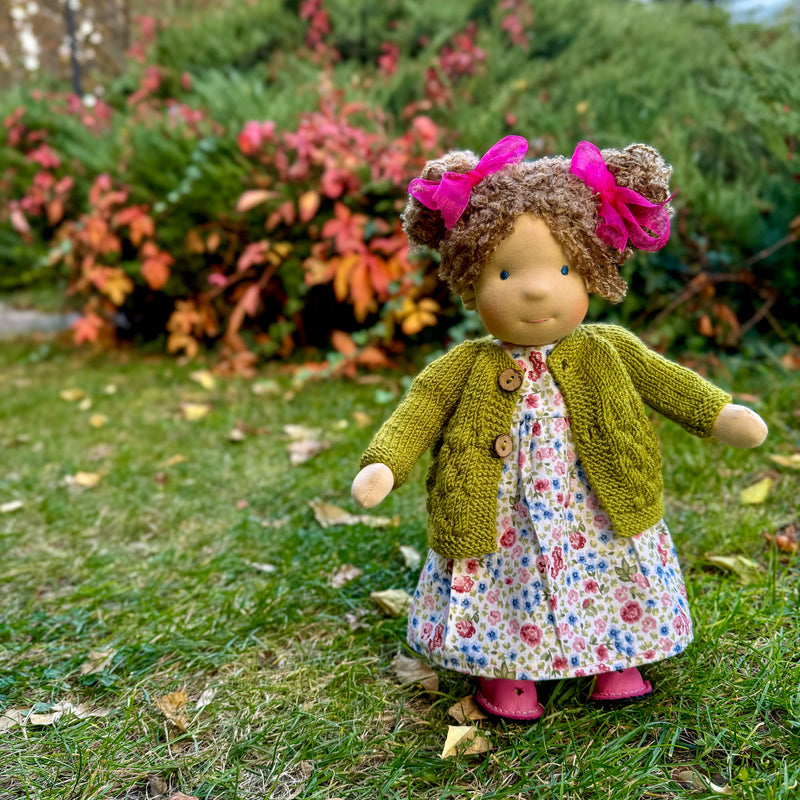
The defining characteristic of a Waldorf toy is intentional simplicity. A Waldorf doll has minimal facial features — not because the maker couldn't add more, but because leaving them minimal is the point. The child fills in the emotional expression. A Waldorf block set has no interlocking mechanism — the child decides how the blocks relate to each other.
This approach is rooted in Steiner's belief that imagination is a faculty that needs to be exercised, and that the best toy for early childhood is one that makes as few decisions as possible, leaving the most to the child.
- Simple, minimal design — no fixed play script
- Natural materials — wool, cotton, wood, silk, beeswax
- No batteries, no electronic components
- Ambiguous enough to become anything in play
- Beautiful but not overstimulating
- Designed to last for years, not seasons
What Makes a Montessori Toy Different
A Montessori material is typically designed with a specific developmental purpose. A set of graduated cylinders teaches size discrimination. A practical life activity — pouring, spooning, buttoning — teaches fine motor control and independence. The toy has a built-in "control of error" — the child can see for themselves when they've done it correctly, without needing adult feedback.
Montessori toys tend to be more purposeful and less ambiguous than Waldorf toys. They're not designed for fantasy play — they're designed for mastery. A child works with a Montessori material until they've learned what it has to teach, then moves on.
Is a Waldorf Doll a Montessori Toy?
Not by definition — but it's compatible with Montessori values. Montessori environments often include soft dolls made from natural materials, used for role play and emotional development. A Waldorf doll fits that description perfectly.
The key difference is that a Waldorf doll is specifically designed for open-ended imaginative play — it has no educational purpose in the Montessori sense. It doesn't teach a specific skill. It creates space for the child to play freely, imaginatively, and without structure. In a Montessori context, that kind of play has its place — it just isn't what Montessori materials are designed for.
Can You Mix Both?
Yes — and many parents do, successfully. The shared values between Waldorf and Montessori are significant: both prefer natural materials, both discourage screens in early childhood, both put the child's developmental needs ahead of adult convenience.
A play environment that includes a Waldorf doll for imaginative play, wooden Montessori puzzles for skill-building, and natural art materials for creativity isn't contradictory. It's simply responsive to the different kinds of play a child needs at different times.
Many parents who describe themselves as "Montessori-inspired" or "Waldorf-inspired" are doing exactly this — drawing from both traditions based on what resonates, without committing fully to either.

A Waldorf doll is designed for one thing above all: leaving as much as possible to the child's imagination.
Which Should You Choose?
Choose Waldorf toys — including a Waldorf doll — if your child is drawn to imaginative, story-based play; if you value simplicity and natural materials above educational purpose; and if you want toys that grow with the child through years of open-ended use.
Choose Montessori materials if your child is independent and self-directed; if you want toys that teach specific practical or cognitive skills; and if you prefer a more structured play environment with purposeful materials.
If you're not sure — try both. Most children benefit from elements of each.
Handmade Waldorf dolls by Heartmade Doll
Organic cotton, natural wool, SGS certified safe. Designed for imagination — not instruction. Ships worldwide in 3–5 days.
Shop Handmade Dolls →Frequently Asked Questions
What is the difference between Waldorf and Montessori toys?
Waldorf toys emphasise imagination and open-ended play with natural materials. Montessori toys emphasise independence and purposeful skill-building. Both value natural materials and screen-free play, but Waldorf leans toward imagination while Montessori leans toward practical mastery.
Is a Waldorf doll a Montessori toy?
Not by definition, but compatible with Montessori values. Montessori environments often include soft natural dolls for role play — a Waldorf doll fits this well. The difference is that Waldorf dolls are designed for open-ended imaginative play, not to teach a specific skill.
Which is better — Waldorf or Montessori?
Neither is universally better. Waldorf suits children drawn to imaginative, artistic play. Montessori suits independent, self-directed children motivated by mastering practical skills. Many parents draw successfully from both traditions.
Can you mix Waldorf and Montessori toys?
Yes — many parents do this successfully. The shared values (natural materials, no screens, child-centred play) mean both approaches complement each other well in the same play environment.