
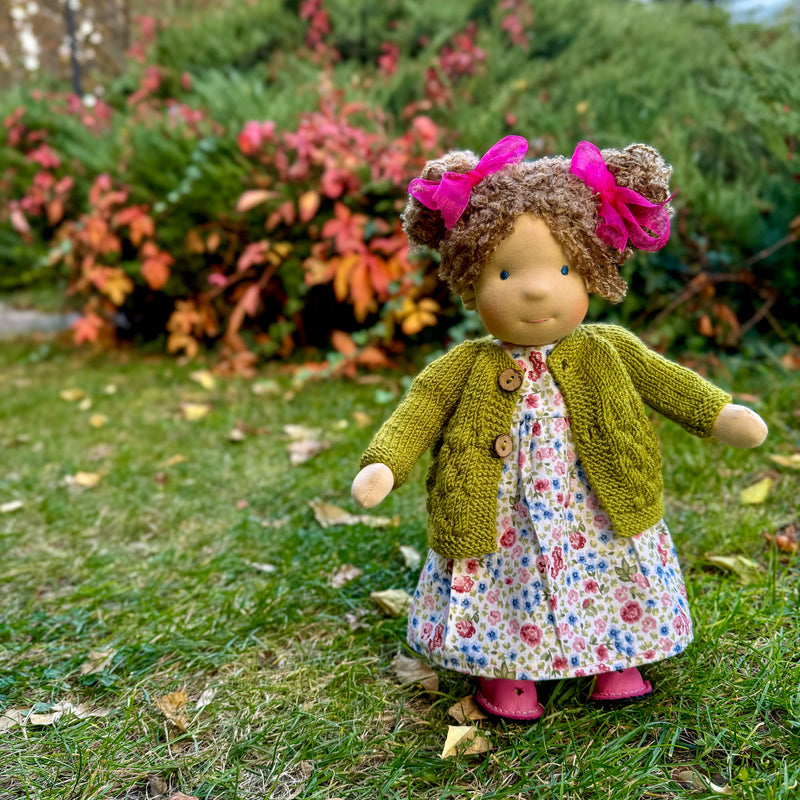
Parents who are looking for a more natural, thoughtful doll for their child often ask how a Waldorf doll compares to a Barbie. It's a fair question — both are dolls, both involve dressing and imaginative play, and both have been given to children for generations. But they're very different toys, designed for different purposes, made from different materials, and supporting very different kinds of play.
Here's an honest, straightforward comparison.
Side-by-Side Comparison
| Category | Waldorf Doll | Barbie |
|---|---|---|
| Materials | Organic cotton, natural wool | Hard ABS plastic |
| Body proportions | Child-like, soft, natural | Exaggerated adult proportions |
| Facial features | Minimal — embroidered, open expression | Detailed, fixed adult expression |
| Target age | 3–7 (peak imaginative play) | 3+ (most relevant 5–10) |
| Play type | Nurturing, open-ended storytelling | Fashion, lifestyle, aspirational |
| Safety certification | SGS / ASTM F963-23 (if reputable) | ASTM compliant (Mattel) |
| Personalisation | Hair, eyes, skin tone to match child | Range of versions available |
| Price | $80–$200 | $10–$50 |
The Materials Difference
The most fundamental difference between a Waldorf doll and a Barbie is what they're made of. A Waldorf doll is soft — organic cotton outside, natural wool inside. It's warm to the touch, flexible, and made from materials that have been used safely in children's products for centuries.
Barbie is hard plastic — ABS (acrylonitrile butadiene styrene), a rigid petroleum-derived polymer. It's durable and allows for the precise detail that makes Barbie's proportions and facial features possible. But it's synthetic, not breathable, and has a different sensory quality from a natural soft toy.
For very young children — ages 3 to 5 — who still carry their doll everywhere, sleep with it, and press it against their face, the tactile difference matters. A soft, natural doll is a different sensory experience from a hard plastic one.
The Proportion Difference
Waldorf dolls have child-like proportions — a relatively large head, soft rounded body, simple limbs. They look like a child might imagine a person to look. This isn't incidental — it's a deliberate design choice rooted in Waldorf philosophy. A doll with child-like proportions invites the child to project themselves into the relationship. The doll is someone to care for, in the way a child is cared for.
Barbie has adult proportions — elongated limbs, defined waist, adult facial features. Research on how children interpret these proportions is mixed, but the general finding is that fashion dolls with adult proportions shift children's play from nurturing to aspirational — from "I am caring for this doll" to "I want to be like this doll." This shift isn't inherently problematic, but it does change the developmental nature of the play.
"A Waldorf doll invites a child to care for someone. A fashion doll invites a child to aspire to something. Both have their place — but not at the same age."
The Play Difference
Waldorf doll play is fundamentally nurturing and open-ended. A child feeds the doll, puts it to sleep, takes it on adventures, tells it stories. The doll has no fixed identity — it becomes whoever the child needs it to be. This kind of play is deeply connected to emotional development, empathy, and imaginative capacity.
Barbie play tends to be more aspirational and lifestyle-oriented. Children dress Barbie, put her in scenarios drawn from adult life, act out social situations. This isn't without developmental value — social role play and understanding of adult life are legitimate areas of child development. But it's a different kind of play, most appropriate for slightly older children.
What Age Are They Each Best For?
This is where the comparison is clearest. Waldorf dolls are most developmentally appropriate for ages 3 to 7 — the peak years for nurturing, imaginative play. For this age group, a soft, natural, open-ended doll supports exactly the kind of play that matters most developmentally.
Barbie becomes most relevant around ages 5 to 10, when children are developing more sophisticated social understanding, interest in adult roles and relationships, and the fine motor skills to manage Barbie's clothing. For a 3 or 4 year old, Barbie is often too small, too detailed, and too aspiration-focused.
- Child is between ages 3 and 6 — peak Waldorf doll years
- You prioritise natural materials and independent safety certification
- You want open-ended, nurturing play rather than aspirational play
- You want a doll that can be personalised to match the child
- You're giving as a baby shower, first birthday, or Christmas gift
- You want something that will last years of daily play
Can They Coexist?
Yes — many children have both, and play with them differently. A 5 or 6 year old might have a Waldorf doll they've loved since age 3 alongside a Barbie they've recently become interested in. The two toys serve different purposes and don't cancel each other out.
For parents choosing a first doll for a young child, a Waldorf doll is the stronger starting point. The nurturing, open-ended play it supports is more developmentally valuable in the 3 to 5 age range than fashion play. Barbie can come later, when the child is developmentally ready for what it offers.

A Waldorf doll's child-like proportions and minimal features are a deliberate design choice — inviting nurturing play, not aspiration.
Handmade Waldorf dolls by Heartmade Doll
Organic cotton, natural wool, child-like proportions. SGS certified safe. Personalised with hair, eyes, and skin tone. Ships worldwide in 3–5 days.
Shop Handmade Dolls →Frequently Asked Questions
What is the difference between a Waldorf doll and a Barbie?
A Waldorf doll is soft, natural-material, child-proportioned, and designed for nurturing open-ended play for ages 3–7. Barbie is hard plastic, adult-proportioned, and designed for fashion and lifestyle play, most relevant from ages 5–10.
Is a Waldorf doll better than a Barbie?
For young children under 6, a Waldorf doll is generally more developmentally appropriate. For older children interested in fashion and lifestyle play, Barbie serves a different purpose. The two toys are designed for different ages and different kinds of play.
What age is a Waldorf doll appropriate for vs Barbie?
Waldorf dolls are most relevant for ages 3–7. Barbie is typically most relevant from ages 5–10. For the 3 to 6 age range, most child development specialists recommend a Waldorf-style doll over a fashion doll.
Are Waldorf dolls a good alternative to Barbie?
Yes — particularly for parents concerned about body image, aspirational marketing, or plastic materials. A Waldorf doll offers dressing and role-play in a natural, human-proportioned format more appropriate for young children.