
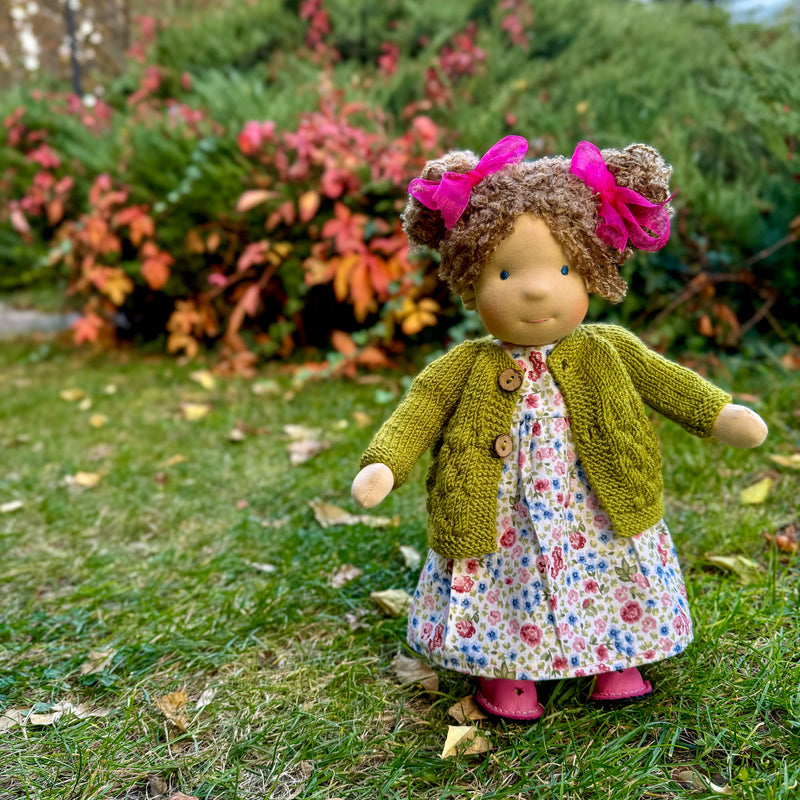
Making your own Waldorf doll is one of the most rewarding craft projects you can undertake — and one of the more challenging. The process is deeply satisfying when it goes well, and genuinely frustrating when it doesn't. Before you begin, it helps to have a clear understanding of what's involved: the materials, the skills, the time, and the realistic gap between a first attempt and a finished doll that looks the way you imagined.
We make Waldorf dolls by hand every day, so we're well placed to give you an honest picture. Here's what you need to know.
What Makes a Waldorf Doll Difficult to Make
The sewing is manageable. If you can cut fabric accurately and sew a seam, you can sew a Waldorf doll body. The challenging step — the one that separates a flat, oddly proportioned doll from one with genuine presence — is the head sculpting.
A Waldorf doll's head is filled with natural wool, then tied, sculpted, and shaped from the outside to create a firm, three-dimensional form. The wool must be packed to the right density — not too loose (the head will be soft and shapeless) and not too hard (the head will feel like a stone). The tying and sculpting requires patience, practice, and a feel for the material that's hard to describe and only comes with repetition.
The facial embroidery is the second difficult step. Placing two small embroidered eyes so that the doll's gaze is balanced, centred, and expressive requires a steady hand and an eye for placement. A millimetre's difference changes the expression significantly.
"The sewing is a craft. The head sculpting is an art. Most beginners find the gap between these two harder than they expected."
What You'll Need
Materials
- Organic cotton or natural cotton jersey — for the body, head, and hands. Jersey (stretchy) is traditional for the head; woven cotton for the body. Buy more than you think you'll need — mistakes happen.
- Natural wool batting or fleece — for filling the head and body. Wool carded batting is traditional. Not polyester stuffing — the density and resilience of wool is what allows the head to be sculpted properly.
- Natural yarn — for the hair. Choose a weight and colour appropriate for the doll's character.
- Embroidery thread — for the facial features. A few colours for the eyes and mouth.
- Strong linen or cotton thread — for tying the head during sculpting. Regular thread will break.
- Basic sewing supplies — sharp scissors, needles, pins, a turning tool for reversing small seams.
Tools
- Sewing machine (or hand sewing needle for the whole project)
- Darning needle for hair attachment
- Embroidery needle for facial features
- Stuffing tool or chopstick for packing wool into limbs
The Making Process — Step by Step
Realistic Expectations for a First Doll
Your first Waldorf doll will probably not look the way you imagined. The head will likely be slightly lopsided, the eyes slightly uneven, the hair slightly thin. This is normal — these are skills that develop with practice, and the gap between a first doll and a fifth doll is substantial.
An experienced maker takes 8 to 15 hours to make a complete doll. A first-time maker should expect 20 to 30 hours or more — with significant time spent on the head sculpting and facial embroidery. The clothing adds several more hours.

A well-made Waldorf doll is the result of many hours of practiced skill — which is why a handmade doll from an experienced maker costs what it does.
When to Buy Instead of Make
Making your own Waldorf doll is worth it if you enjoy the craft, have time to practice, and find the process itself rewarding — not just the finished product. If the goal is a beautifully made doll that a child will love, buying from an experienced maker is likely to produce a better result at less cost of time and frustration, particularly for a first-time maker.
A Heartmade Doll is made by artisans who have made hundreds of dolls — the head sculpting, facial embroidery, and hair attachment are the result of years of practice. The materials (organic cotton, natural wool) are the same as you'd use yourself. And at $114 complete — dress, cardigan, shoes, teddy bear — the cost compares favourably with the material cost plus 20+ hours of a first attempt.
- Organic cotton jersey — for head and body
- Natural wool batting — for filling and head sculpting
- Natural yarn — for hair
- Embroidery thread — for facial features
- Strong linen thread — for head tying
- A good pattern — with detailed head sculpting instructions
- Time: 20–30 hours for a first doll
Shop handmade Waldorf dolls by Heartmade Doll
Organic cotton, natural wool, hundreds of dolls of experience behind every stitch. Personalised to order. Ships worldwide in 3–5 days.
Shop Handmade Dolls →Frequently Asked Questions
How hard is it to make a Waldorf doll?
Moderately advanced. The sewing is manageable for someone with basic skills, but the head sculpting — packing and shaping natural wool into a firm, rounded three-dimensional form — requires patience and practice. Most beginners find this the most challenging step. A first doll rarely looks as good as a fifth or tenth.
What materials do you need to make a Waldorf doll?
Organic or natural cotton jersey, natural wool batting (not polyester), natural yarn for hair, embroidery thread, strong linen thread for head sculpting, and standard sewing supplies. For clothing: fabric, fastenings, and for the cardigan, knitting needles and natural wool yarn.
How long does it take to make a Waldorf doll?
8–15 hours for an experienced maker; 20–30 hours or more for a first-time maker. Clothing adds several more hours. This is why professionally made Waldorf dolls cost what they do.
Where can I find a Waldorf doll pattern?
Specialist craft publishers (Maricke Kok's 'Making Waldorf Dolls' is a well-regarded starting point) and Etsy from independent designers. Look for patterns with detailed head sculpting instructions — this is the step where most beginners need the most guidance.