
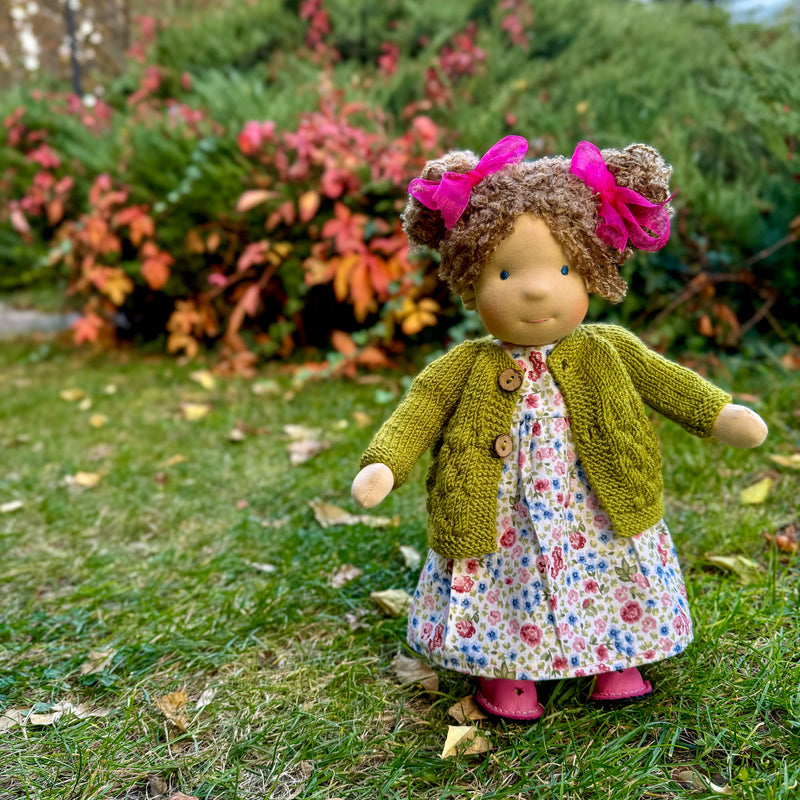
"Handcrafted" has become one of the most overused words in toy marketing. It appears on mass-produced items assembled in factories, on dolls made with synthetic materials and polyester filling, and on products that use the word to imply quality they don't actually deliver. For parents who genuinely want a handmade toy for their child, the word alone is not enough.
Here's what actually separates a well-made handcrafted doll from one that just borrows the language.
What "Handcrafted" Should Actually Mean
A genuinely handcrafted doll is one where the key production steps are performed by a skilled person making decisions in real time — not by a machine following a programme. For a doll, this includes:
- Cutting the fabric by hand — precise cuts that determine the doll's proportions
- Sewing the body — seams that will hold through years of pulling, squeezing, and washing
- Filling and sculpting the head — natural wool packed and shaped to create a specific form
- Embroidering the facial features — placed by hand, by eye, with the skill to get the expression right
- Attaching the hair — yarn fixed securely enough to survive years of handling
- Making the clothing — sewn and knitted to fit the doll properly
Each of these steps requires skill, time, and judgement. A factory can automate some of them — but the steps that define a Waldorf doll cannot be automated without losing what makes the doll what it is.
"Handcrafted is a description of how something is made — not a guarantee of quality. The quality comes from what's in it and who made it."
The Signals of Genuine Quality
Natural materials, specifically stated
A quality handcrafted doll uses organic cotton for the body, natural wool for the filling, and natural yarn for the hair. These aren't just marketing choices — they're materials decisions that affect how the doll feels, how long it lasts, and what a child is in contact with during daily play. A maker who knows their materials will state them specifically. "Soft fabric" and "natural materials" without specifics are red flags.
Independent safety certification
Any seller can describe their doll as safe or non-toxic. The standard of evidence that actually matters is independent third-party testing by a recognised body — SGS, Intertek, Bureau Veritas — against a specific safety standard like ASTM F963-23. A genuine maker will provide a certification number. If they can't, the safety claim is unverified.
Made to order, not from stock
A genuinely handcrafted doll takes time to make. If a seller offers same-day or next-day dispatch on a "handcrafted" doll, it isn't being made when you order it — it was made in advance, in stock, likely in a production setting that doesn't match the handcrafted label. A real made-to-order doll takes 3 to 5 business days minimum.
Slight variation between dolls
Handmade means no two dolls are identical. The hair placement, the precise expression of the embroidered face, the exact shape of the head — these vary slightly from doll to doll in a genuinely handmade product. If every product photo looks machine-perfect and identical, the production process is probably more mechanised than the marketing suggests.
A maker you can ask questions
A genuine artisan can answer specific questions about their materials, their process, and their certifications. They know where their cotton comes from, what's in their filling, and how their safety testing was conducted. Sellers who can't or won't answer these questions may not know the answers themselves — which tells you something about their relationship to what they're selling.


Every Heartmade Doll is made to order in Ankara, Turkey — each one slightly different, because each one is made by hand.
Red Flags in Handcrafted Doll Marketing
- "Handcrafted" with no information about who made it or where — genuine makers are proud of their origins
- Same-day or 1-day dispatch — incompatible with genuine made-to-order handcraft
- Very low prices — organic cotton, natural wool, independent safety testing, and skilled handwork have a cost; prices well below $80 usually mean shortcuts
- No safety certification, or vague safety claims — "non-toxic" without a report number is marketing, not evidence
- Stock photos instead of real product photos — the doll you receive should look like the photos
- No customer reviews or very recent seller history — a track record matters for a product in daily contact with a child
Why a Well-Made Handcrafted Doll Is Worth the Price
A genuine handcrafted doll costs more than a mass-produced plastic alternative — and the price reflects something real. The organic cotton costs more. The natural wool filling costs more. The independent safety testing costs money and time. The skilled hours of cutting, sewing, sculpting, embroidering, and knitting cannot be replicated at machine speed.
But the value proposition over time is often stronger than it first appears. A well-made handcrafted doll lasts — not months, but years. It survives daily play, regular washing, and the full force of a child's affection. It can be repaired. It can be passed to a sibling. Many families find that a handcrafted doll bought once outlasts many cycles of cheaper toys, at a lower long-term cost.
- Made to order in Ankara, Turkey — production begins when you order
- Organic cotton body, natural wool filling, natural yarn hair
- Head sculpted and face embroidered by hand, each doll individually
- Hand-knitted natural wool cardigan, genuine leather shoes
- SGS certified to ASTM F963-23 — Report No. TR2769587
- 2,600+ dolls made and sold across 40+ countries
- 800+ verified five-star reviews
Shop our handmade Waldorf dolls
Organic cotton, natural wool, SGS certified safe. Made to order in Ankara — every doll slightly different, because every doll is made by hand.
Shop Handmade Dolls →Frequently Asked Questions
What makes a handcrafted doll worth buying?
Verified natural materials, independent safety certification with a report number, skilled construction built to last, complete clothing in the price, and a transparent maker with a genuine track record. The word "handcrafted" alone means nothing without these qualities.
How can you tell if a doll is truly handmade?
Signs include slight variation between dolls, a production timeline that reflects actual making time (3–5 days minimum), photos of the real making process, a maker who can answer specific materials questions, and a made-to-order rather than stock model.
Are handcrafted dolls safe for children?
A well-made handcrafted doll from a certified maker is among the safest toys available. Always ask for independent safety certification with a verifiable report number — "non-toxic" claims without documentation are unverified.
Why are handcrafted dolls more expensive?
Because of the time, skill, and materials involved. Organic cotton, natural wool, independent safety testing, and skilled handwork all have a cost. The price reflects what's actually in the doll — and a well-made handcrafted doll typically outlasts many cycles of cheaper alternatives.