
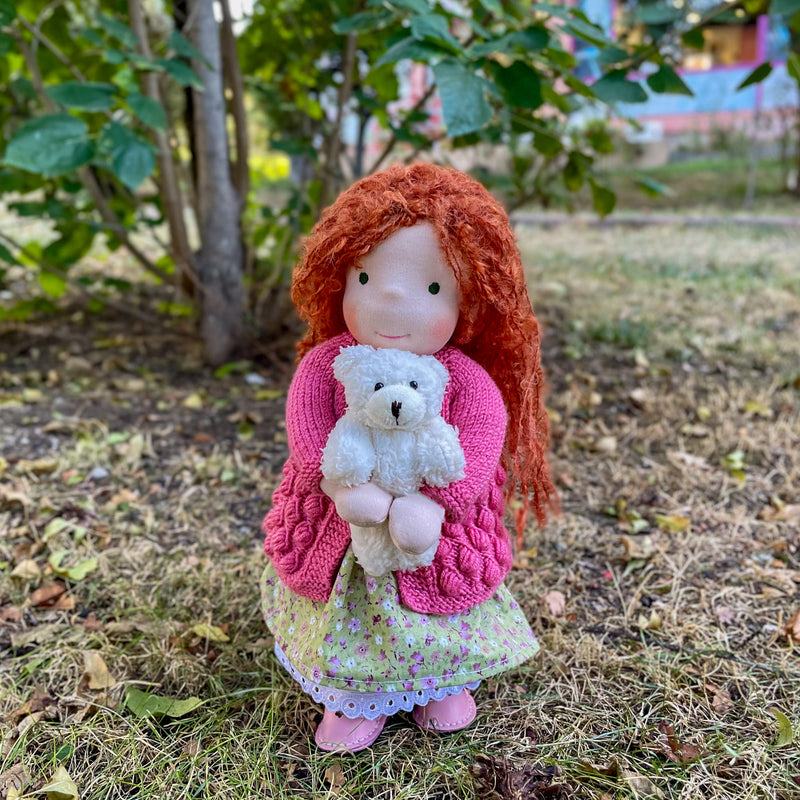
You've chosen a handmade Waldorf doll carefully. It's arrived — beautiful, natural, exactly what you hoped for. And your child looks at it, picks it up briefly, and goes back to whatever they were doing.
Don't panic. This is more common than most parents expect — and it usually resolves itself with a little patience and the right approach. Here's how to introduce a Waldorf doll in a way that gives it the best chance of becoming a genuine companion.
Why the Introduction Matters
A Waldorf doll is fundamentally different from the toys most children encounter. It does nothing on its own. It doesn't flash, beep, talk, or respond. For a child used to stimulating electronic toys, a simple cloth doll can seem, at first, underwhelming.
The connection a child develops with a Waldorf doll is built over time — through play, through story, through daily proximity. The introduction sets the tone for that relationship. A rushed or over-directed introduction can inadvertently signal to the child that this toy needs to be played with in a specific way, which is precisely the opposite of what a Waldorf doll is for.
"The goal isn't to make the child love the doll immediately. It's to give the doll a place in the child's world and let the relationship develop at its own pace."
Step by Step: How to Introduce a Waldorf Doll
What Not to Do
- Don't make a big ceremony of it — pressure and expectation can make a child resistant before they've had a chance to connect
- Don't suggest how to play — "why don't you feed the doll?" or "you could dress her up" directs the play in ways that undermine the child's ownership of it
- Don't compare it to other toys — "this is much better than your plastic toys" creates a contest the doll doesn't need to win
- Don't worry if they ignore it at first — proximity matters more than immediate engagement
- Don't keep it pristine — a doll kept on a display shelf doesn't become a companion; it becomes an object. Let the child play with it freely, knowing it can be washed and repaired.
- The child gives the doll a name
- The child puts the doll to bed or covers it with a cloth
- The child includes the doll in pretend play without prompting
- The child asks to bring the doll on outings
- The child shows concern if the doll is left somewhere
- The child begins dressing and undressing the doll independently
What If My Child Doesn't Connect?
If several weeks have passed and the child still shows no interest, it's worth considering a few things:
Is the child developmentally ready?
Waldorf dolls are recommended for ages 3 and above. A child under 3 may not yet be in the developmental stage where nurturing play and imaginative role play feel natural. Give it more time, or wait until the child is closer to 3.
Is the environment too stimulating?
A child surrounded by loud, flashy, battery-powered toys may find a quiet doll initially underwhelming by comparison. Reducing the overall stimulation level of the play environment often helps — fewer toys, quieter ones, more unstructured time.
Has a sibling or adult modelled play?
Children often take cues from the people around them. A sibling who plays with a doll, or a parent who quietly interacts with it, can spark a child's interest more effectively than any direct suggestion.

The connection between a child and their Waldorf doll builds over time — through daily proximity, naming, and the slow accumulation of shared story.
When the Doll Becomes a Companion
When a child has truly connected with a Waldorf doll, you'll know it. The doll gets a name, a personality, a history. It goes everywhere. It gets tucked in at night. It features in stories told to other children. It becomes, in the truest sense, a companion — not a toy to be played with, but a presence to be lived with.
This kind of connection doesn't happen with every toy. It rarely happens with electronic toys at all. It happens with simple, natural toys that leave enough space for the child to bring themselves to the relationship. A Waldorf doll, introduced patiently and wisely, is one of the most likely candidates for this kind of enduring connection.
Handmade Waldorf dolls by Heartmade Doll
Organic cotton, natural wool, SGS certified safe. Made to be played with, named, and loved for years. Ships worldwide in 3–5 days.
Shop Handmade Dolls →Frequently Asked Questions
How do I introduce a Waldorf doll to my child?
Place it quietly in the child's environment and let them discover it at their own pace. Avoid ceremony or direction. Model gentle care without telling the child how to play. Include the doll in daily rhythms — mealtimes, bedtime, outings.
What if my child doesn't play with their Waldorf doll?
Give it time — a week or two of quiet presence. Consider whether the child is developmentally ready (ages 3+), whether the environment is too stimulating, and whether a sibling or adult has modelled play. The connection usually develops naturally when the child is ready.
Should I name the Waldorf doll before giving it to my child?
Generally no — let the child name it themselves. The naming is part of the connection. If it's a gift presentation, you might suggest a name gently without insisting.
At what age should I introduce a Waldorf doll?
Age 3 is ideal — children are developmentally ready for imaginative, nurturing play. Most Waldorf dolls are recommended for ages 3 and above due to small details like yarn hair and removable accessories.