
The toy aisle has never offered more choice — and never made it harder to choose well. At one end, mass-produced toys at prices that seem hard to argue with. At the other, handmade toys with price tags that require justification. Between them, a marketing landscape where "handcrafted," "natural," and "safe" appear on products that are none of these things.
Here's an honest assessment of what actually differs between genuinely handmade and mass-produced toys — and what those differences mean for the child who plays with them.
The Fundamental Difference: Who Makes Decisions
Mass production optimises for cost. Every material choice, every construction decision, every design element is evaluated against the question: can we do this cheaper? The result is toys that hit a price point at the expense of other qualities — materials, durability, safety transparency, and sometimes developmental intent.
Handmade production optimises for the toy. The maker chooses materials based on what's best for the finished product and the child who uses it. The construction takes as long as it takes. The design serves the play. This isn't romanticism — it's a description of the different incentive structure that shapes every decision.
"Mass production optimises for the price. Handmade optimises for the toy. These are genuinely different things."
Side-by-Side Comparison
| Category | Handmade Toy | Mass-Produced Toy |
|---|---|---|
| Materials | Natural — wood, cotton, wool chosen for quality | Synthetic — plastic, polyester, chosen for cost |
| Construction | Skilled by hand — decisions made in real time | Automated — consistent but optimised for speed |
| Durability | Built to last years — repaired when needed | Built for short-term use — replaced when broken |
| Safety transparency | Maker knows materials — certification verifiable | Supply chain opacity — materials harder to verify |
| Environmental impact | Lower — natural materials, smaller volumes | Higher — plastic production, high waste volumes |
| Play value | Often open-ended — child generates the content | Often closed-ended — toy generates the content |
| Personalisation | Possible — made to order | Not possible — mass uniform |
| Price | Higher — reflects actual cost of making | Lower — reflects scale and synthetic materials |
Materials: The Biggest Practical Difference
The most significant day-to-day difference between handmade and mass-produced toys is materials. Mass-produced toys are overwhelmingly plastic — ABS, PVC, polypropylene, polyester — petroleum-derived materials that are cheap to produce, easy to mould into any shape, and persistent in the environment for hundreds of years after disposal.
A well-made handmade toy uses natural materials — solid wood, organic cotton, natural wool, beeswax, genuine leather. These materials cost more. They're harder to work with. They require more skill to use well. But they're safer (no phthalates, no synthetic dyes from unknown sources), more pleasant to touch, and biodegradable at end of life.
For a toy in daily contact with a young child — held, mouthed, slept with, carried everywhere — the material difference is not trivial.
Durability: The Long-View Calculation
Mass-produced toys are typically designed for a short product lifecycle. The business model depends on replacement — a toy that lasts a decade is a toy the family doesn't buy again. The incentive to build for durability is weak.
Handmade toys from natural materials, made by a skilled maker who takes pride in their work, are built to last. Not because of any stated commitment, but because of the materials themselves — wool that compacts rather than flattening, organic cotton that softens rather than pilling, wood that ages rather than cracking.
The long-view calculation is interesting: a $20 plastic toy replaced five times in a decade costs $100 and produces five units of landfill. A $114 handmade doll that lasts the same decade costs less, produces a fraction of the waste, and often passes to a second child.
Safety Transparency
Mass production involves long, complex supply chains where the original maker often doesn't know precisely what's in their product. The plastic comes from a supplier, who sourced the raw material from another supplier, who used additives from a third. This opacity makes safety claims difficult to verify and recalls difficult to trace.
A skilled artisan who makes toys by hand knows exactly what's in each one. They chose the fabric, the filling, the dye. When they say "organic cotton," they know which supplier they're buying from. When they provide a safety certification, it applies to the actual toy as made — not to an idealized specification.
Play Value: Open vs Closed
Mass-produced toys tend to be closed-ended — they have a specific function, a programmed response, a fixed play script. The child reacts to what the toy does. This isn't without value, but it positions the child as a consumer of the toy's content rather than a creator of their own.
Well-designed handmade toys tend to be open-ended — simple, natural, ambiguous enough to become whatever the child needs. A wooden block, a simple doll, a piece of silk. These toys generate nothing on their own; everything comes from the child. This is where the most important developmental work of early childhood happens.

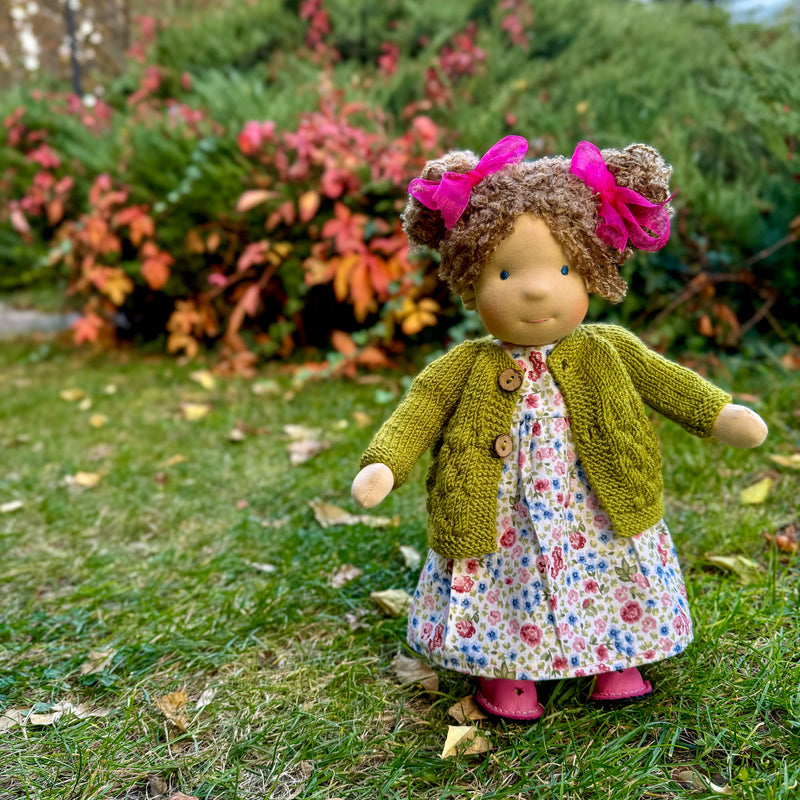
Every Heartmade Doll is made by hand, from materials chosen for quality — not to hit a price point.
When Mass-Produced Is Fine
Not every toy needs to be handmade. A mass-produced wooden puzzle from a reputable brand can be excellent. A well-made board game from a major manufacturer can provide years of value. The concern isn't with mass production as a category — it's with the specific failures that the pressure to minimise cost produces: synthetic materials, poor durability, safety opacity, and closed-ended design.
The case for handmade is strongest for toys that are in close daily contact with a young child — soft toys, dolls, comfort objects. For those, the material quality, safety transparency, and open-ended design of a well-made handmade toy represent genuine advantages that justify the price difference.
- Every doll made to order — production begins when you place your order
- Organic cotton and natural wool — chosen for quality, not cost
- Head sculpted and face embroidered by hand — no two dolls identical
- SGS certified to ASTM F963-23 — Report No. TR2769587
- 3–5 business days production — reflecting actual making time
- Built to last a decade of daily play — not a season
Handmade Waldorf dolls by Heartmade Doll
Organic cotton, natural wool, SGS certified safe. Made to order in Ankara. A toy built the way toys used to be — with materials and time that reflect what a child deserves.
Shop Handmade Dolls →Frequently Asked Questions
Are handmade toys better than mass-produced toys?
For primary toys in daily contact with young children, handmade from natural materials is usually the stronger choice — better materials, greater safety transparency, and more open-ended play value. For secondary toys and games, mass-produced from reputable brands can be perfectly good.
Why are handmade toys more expensive?
Skilled labour, natural materials, and smaller production volumes. The price reflects what's actually in the toy. A well-made handmade toy typically outlasts many cycles of cheaper alternatives — making the long-term cost lower than it first appears.
What are the disadvantages of mass-produced toys?
Synthetic materials, environmental impact, short lifespan designed for replacement, and supply chain opacity that makes safety claims hard to verify. Not all mass-produced toys have all of these problems — but the category's worst examples combine all four.
How do you tell if a handmade toy is genuinely handmade?
Slight variation between products, production timelines reflecting actual making time (3–5 days minimum), photos of the real making process, and a maker who can answer specific questions about materials. Same-day dispatch on a "handmade" product is usually a red flag.