
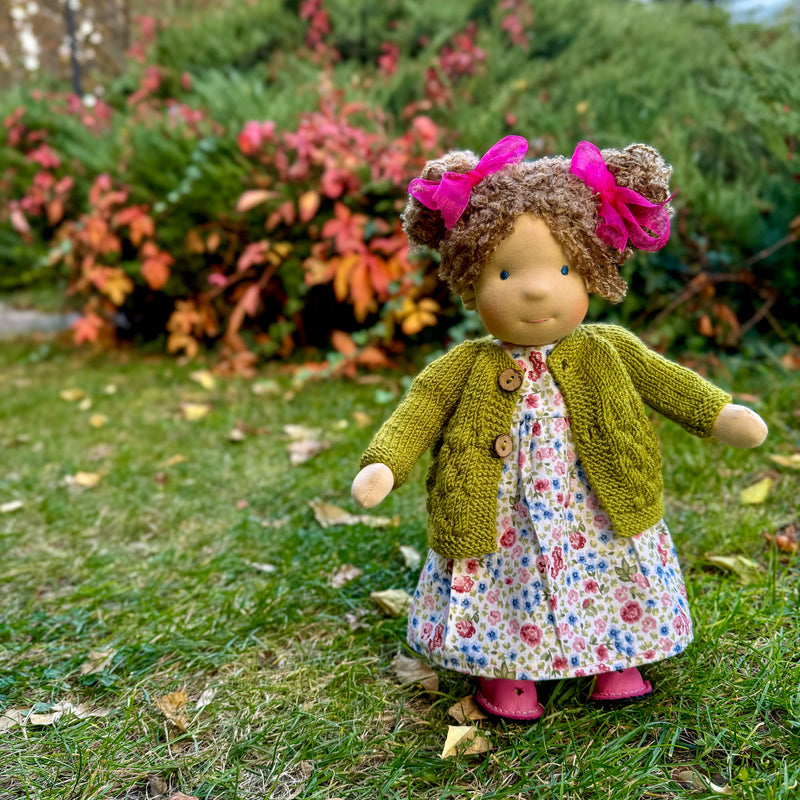
When you personalise a Waldorf doll, the eye colour is the third of the three decisions — alongside hair colour and skin tone — that together determine whether the doll looks like the child it was made for. Of the three, eye colour is the subtlest: the embroidered eyes on a Waldorf doll are small and gentle. But they're also the feature that gives the doll its particular expression and presence, and the detail that children often notice first.
Here's everything you need to know about Waldorf doll eye colours — what's available, how they're made, and how to choose.
How Waldorf Doll Eyes Are Made
Waldorf doll eyes are embroidered by hand using coloured thread. There are no plastic components — no safety eyes, no buttons, nothing that can detach. The embroidered eye is placed by the maker by eye, by hand, which means each doll's expression is subtly individual. Even two dolls ordered with the same specifications will have a slightly different quality of gaze — a natural consequence of handcraft.
This is a feature, not an inconsistency. The handmade eye gives each Waldorf doll its distinctive presence — the quality that makes children say the doll is "looking at them." A printed or moulded plastic eye cannot produce the same effect.
"The embroidered eye is the detail that gives a Waldorf doll its presence. It's small — but it's the first thing a child notices."
Why Waldorf Dolls Have Minimal Facial Features
Before choosing an eye colour, it's worth understanding why Waldorf doll eyes are minimal by design. Rudolf Steiner's educational philosophy held that a doll with a fixed, detailed expression limits the child's imaginative projection — if the doll always smiles, it can only ever be happy. A doll with soft, open features can be whatever the child needs it to be: happy, sad, tired, brave, scared.
The minimal eye — a gentle curve of embroidery, sometimes with a small highlight — is not a compromise. It's the intended design. The eye says "I am looking at you" without saying anything more specific than that.
Eye Color Options at Heartmade Doll
How to Choose the Right Eye Color
Match the child's eyes
The most meaningful choice — and the one most parents and gift-givers make — is to match the child's actual eye colour. Along with hair colour and skin tone, it's what makes the doll feel like it was made specifically for this child. When a child sees a doll that shares their colouring, the recognition is immediate and powerful.
When you're buying as a gift
If you're choosing a doll as a gift and aren't certain of the child's eye colour, hazel is the most versatile option — it works across the widest range of combinations. Brown is a strong second choice for children with darker colouring. If you know the child well enough to know their hair colour and skin tone, you can usually narrow down the eye colour from there.
When the child's eyes are between shades
Many children have eyes that shift between colours — blue-green, brown-hazel, grey-blue. In these cases, choose the shade that most dominates, or the one the child themselves most identifies with. The embroidered result will read as the colour you choose regardless of subtle variation.
For a gift before the baby is born
Newborn eye colours often change in the first months — many babies are born with blue eyes that shift to brown or hazel. If you're ordering a doll before the baby is born or before their eye colour has settled, hazel is often the safest choice — a warm neutral that works well across possibilities.

The embroidered eye is placed by hand — which is why each Heartmade Doll has a subtly individual expression, even between dolls with the same specifications.
The Complete Personalisation
Eye colour is the final piece of the three-part personalisation that makes a Heartmade Doll genuinely specific to one child. Together — skin tone, hair colour, eye colour — they create a doll that a child looks at and recognises as themselves. This recognition is the foundation of the deep attachment many children form with their Waldorf doll.
- Four eye colours — blue, green, hazel, brown
- Embroidered by hand — no plastic components
- Chosen as part of the full personalisation (skin tone + hair + eyes)
- Each doll subtly individual — handcraft means no two are identical
- If unsure: hazel is the most versatile choice
- Available for both girl and boy dolls
Choose the eyes, hair and skin tone
Every Heartmade Doll is personalised to order — eye colour, hair colour, and skin tone chosen by you. Organic cotton, natural wool, SGS certified safe.
Design Your Own Doll →Frequently Asked Questions
What eye colors do Waldorf dolls come in?
At Heartmade Doll: blue, green, hazel, and brown — all embroidered by hand. Chosen alongside hair colour and skin tone as part of the full personalisation.
How are Waldorf doll eyes made?
Embroidered by hand using coloured thread — no plastic components. Each doll's expression is subtly individual as a result of handcraft. The embroidered eye gives each doll its distinctive, gentle presence.
Should I match the eye color to the child's eyes?
Matching is the most meaningful choice. If you're buying as a gift and aren't sure, hazel is the most versatile option — it works across the widest range of combinations.
Why do Waldorf dolls have minimal facial features?
A deliberate design choice. Minimal features allow the child to project any emotional state onto the doll — the doll can be happy, sad, tired, or brave, depending on what the child needs. A fixed, detailed expression limits this imaginative flexibility.